Resources
Industry insights, product updates & customer wins
Stay up to date with industry insights, customer stories, and product improvements—everything to help you quote faster and run smoother.
Success stories
0
min read
From quoting crunches to streamlined processes: Tempus Tools empowers growth of J&T Steel Sales
As J&T Steel Sales expanded into the fast-growing laser cutting market, outdated spreadsheet-based quoting quickly became a bottleneck for delivering fast, reliable service. By adopting Tempus Tools, the team streamlined quoting, order tracking, and invoicing—freeing up time, improving consistency, and supporting the company’s growth as they scale their laser cutting operations.
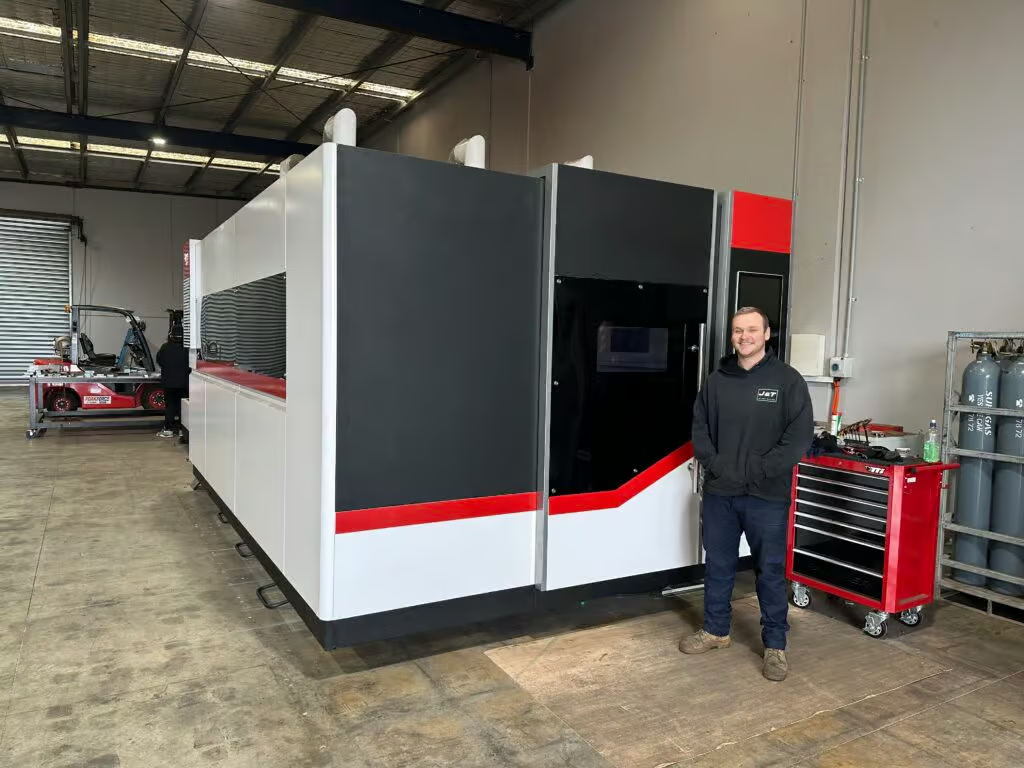
Expanding Australian metal fabrication specialist, J&T Steel Sales, has found that improved productivity and new equipment is only half the battle to boost customer service and sales – equally important is eliminating the outdated processes used to track and prepare quotes, delivery, and invoices.
J&T Steel Sales began as a small plate processing business in Victoria with a CNC Plasma machine, where staff used spreadsheets to develop quotes for customers, but the company has now made the move into the high demand laser cutting market.
Part of the motivation for the expansion was a need in the market for better lead times on laser cut metal products, including aluminium, stainless steel, and carbon steel.
“We had customers come and beg us to purchase a laser machine, because they were fed up with the long lead times that were becoming increasingly common for laser cut products,” explains Luke Patterson, Operations Manager, J&T Steel Sales.
“So we invested in a laser cutting machine, and prepared to grow our business to the next level. But with this change, we needed a quick and efficient software solution to export a presentable quote that we can forward directly to customers in a timely fashion. Spreadsheets just weren’t going to work anymore, so we did some research and found Tempus Tools,” he said.
Laser cutting quoting software streamlines operationsTempus Tools, is a multi-functional laser cutting quoting software that is provided using a SaaS (Software as a Service) model. Tempus Tools was developed specifically for the laser cutting industry, and is designed to save job shops time, and make quoting more efficient, accurate, and consistent.
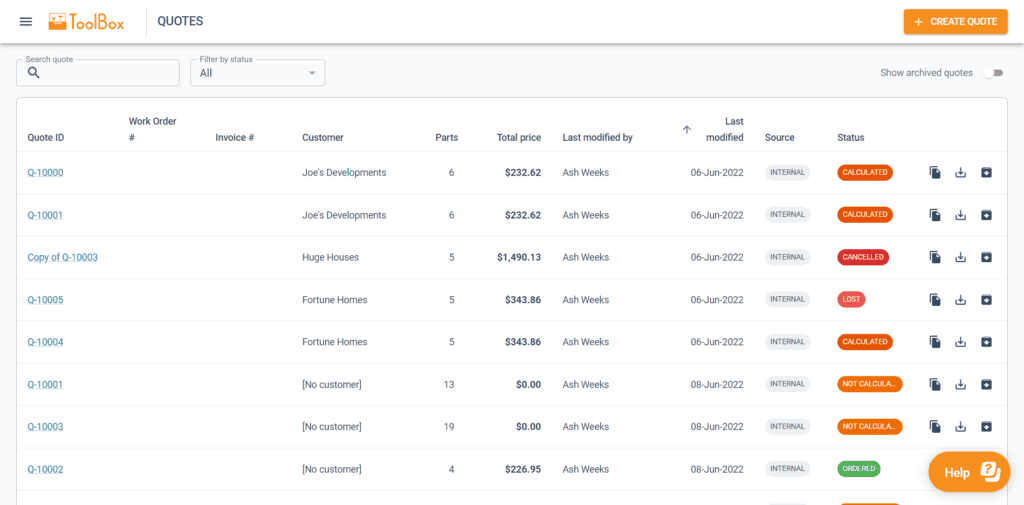
“Tempus Tools has allowed us to streamline not only the quoting aspect, but also the tracking of active orders as well as invoicing,” says Luke.
“It has been able to take most of the heavy lifting in cutting back on excess paper waste in our offices, whilst also creating a digital paper trail to be able to track material usage and stock.”
Since purchasing the laser cutting machine, J&T Steel Sales has committed to getting customers their parts when they need them, calling it “the J&T Guarantee”.
“Tempus Tools has helped us immensely in delivering this guarantee to our customers. It has taken the stresses and late night quoting crunches and completely streamlined the process, freeing up more time for us to be able to focus on growing the business,” says Luke.
“In the past, expanding our customer base meant we would fall increasingly behind when it came to invoicing and quoting. Now, with Tempus Tools, we really feel we have found a software that not only services us now, but also allows us room to grow in the future.”
Service is key
Luke explains that in his business, customer service is the key to success. Customers have good memories, and they value pricing consistency, accuracy, and reliability.
“Being a service-focused business, it’s something I look for in our suppliers too. In my opinion, the Tempus Tools team has been exceptional when it comes to responsiveness and availability to work through any challenges I’m experiencing,” he says.
“Coming from a small business ourselves it was an incredibly refreshing experience to have team members visit our workshop, and to also feel listened to when it came to our concerns or feedback for the future development of Tempus Tools.”
“I met Mark Washington (Sales & Support) and Felipe Lechuga (Director) from Tempus Tools at a local manufacturing expo earlier this year, and they took the time to visit our job shop and discuss the functionality of Tempus Tools, and what more it could be doing for us. I was very impressed, and I’m grateful for all the support.”
A bright future
J&T Steel Sales has seen steady growth since moving into the laser cutting business, and Luke has plans to continue this trend.
“Our future plans are not only to focus on bringing in new customers – ideally ones that require repeat work – but also to let all our customers know about our bending and fabrication facility, so they know we can provide an end-to-end manufacturing solution,” he says.
“Tempus Tools has a huge range of useful features, and the development team is always working on new functionality that can benefit job shops like ours, so it is a key component of our growth plans.”
To learn more about Tempus Tools, please click here.
Read blog
Product updates
0
min read
Tempus Tools’ Google Drive integration: 6 ways to supercharge your job shop efficiency
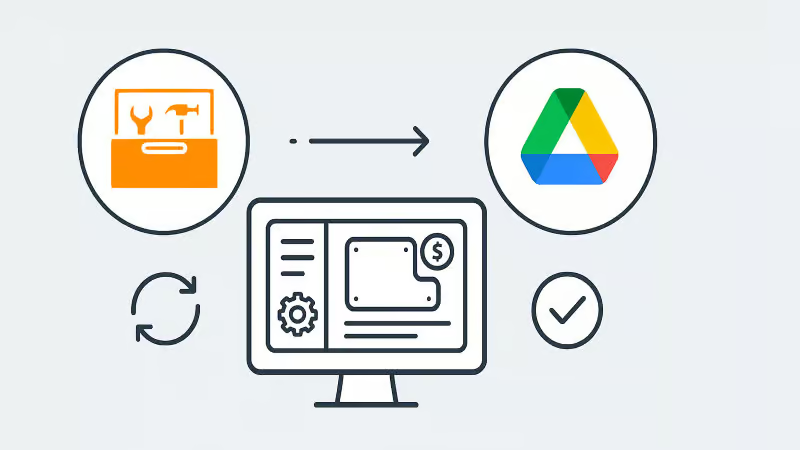
Last month Tempus Tools released a powerful new feature: seamless integration with Google Drive.
Since then, we’ve heard from lots of customers about the innovative ways they have implemented this integration in their job shops, and we wanted to share the best six with you to inspire you to use the feature in your shop.
First, a quick recap: with the Google Drive integration, all your quote data (in CSV format) and production-ready part files can be automatically saved to your chosen Google Drive folder. From here, they can be exported to any number of programs or that data can be manipulated for many use cases, opening up a world of automation, reporting and connectivity for your job shop. We’ve also put together a quick video to show the integration in action.
1. Automate quote data collection for reporting
With every quote automatically saved, you can easily compile and analyse your quote performance over time. Use Google Sheets or your favourite analytics tool to track:
- win/loss rates
- performance across material types
- average order size
- breakdown of secondary processes contributions
This data-driven approach helps you identify trends, optimise pricing and improve customer response times.
2. Connect with ERP/MRP and other business systems
Some apps have native integration with Google Drive, which makes taking in quote data and parts easy, but many need a formal API. Luckily, Google Drive comes with its own API.
Some users have used the Google Drive API to build automations that push quote data directly into ERP, MRP or order management systems. This can streamline order processing, reduce manual data entry and ensure your production schedule is always up to date.
3. Organise your orders by material type
Use the exported quote data to create a parts planner that groups jobs by common material type. This enables you to:
- batch similar jobs for more efficient material usage
- reduce changeover times on machines
- optimise purchasing and inventory management
A simple Google Sheets script or integration with a dashboard tool can make this process nearly automatic.
4. Integrate with project management tools
Connect your quote data with popular tools like ClickUp, Monday.com or Airtable. Build custom dashboards and planners for your factory, visualise job statuses and assign tasks to your team-all based on real-time quoting data. These tools don’t require coding or a developer and anyone can work wonders. These types of projects boost collaboration on the shop floor and keep everyone aligned on priorities.
5. Create a scheduling calendar from time calculations
Use the time estimates in your quote data to automatically populate a production calendar. With a Google Calendar integration, you can:
- visualise machine and operator workloads
- identify bottlenecks before they happen
- easily adjust schedules as new jobs come in
This proactive scheduling helps you deliver on time, every time.
6. Enable automated notifications and workflows
Set up Google Drive triggers (using tools like Zapier or Google Apps Script) to notify your team when new quotes are confirmed as orders, or to kick off downstream processes-like updating CRM records or ordering materials.
Getting started is easy
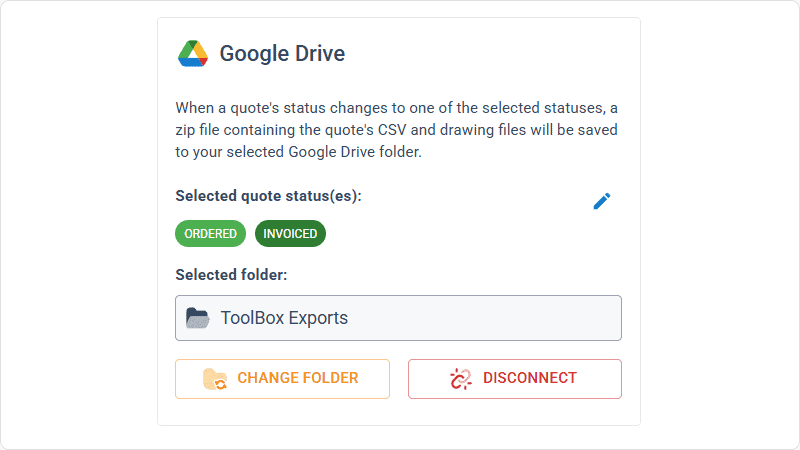
- Go to Settings > Organisation settings > Integrations in your Tempus Tools Tempus Tools account
- Connect your Google Drive and select your preferred folder
- Choose the quote statuses that will trigger automatic file saving
- Start building automations and workflows that fit your shop’s needs
This integration is designed to be flexible-whether you want to automate reporting, connect with business systems, or simply keep your files organised, Tempus Tools and Google Drive make it possible.
Ready to enhance your job shop efficiency? Try the new Google Drive integration today.
Read blog

Articles
0
min read
Is expensive, non-dedicated software holding you back from effortless laser cutting quoting?
Laser cutting is a precise task, requiring machinery tailored to specific requirements. Profitability is significantly boosted by the ability to be able to respond quickly to customer requests for quotes (RFQs), and efficiently deliver the product.
“With the time and energy often spent on selecting the right laser cutting machine, it’s amazing how often software is overlooked as a driver of productivity,” says Tempus Tools Head of Global Sales, Mark Washington.

“Sometimes laser cutting companies are stuck using software that wasn’t specifically designed for job shops, but it’s all that their team is used to using. Other times, expensive software is implemented, but only a small fraction of the features are actually used,” he says.
“And in many cases, it becomes so complex that a specialist is hired to manage quoting via the software – but what happens if they leave the company?”
Tempus Tools is the creator of dedicated quoting software, Tempus Tools, which can provide fast, accurate, and consistent laser cutting quotes that are professionally presented, ready to send back to the customer.
“Using software that isn’t specifically designed for laser cutting is like using a cricket bat to play tennis. It might get the job done, but it would be far more efficient and accurate with the tools designed for the job!” says Mark (pictured, right).
“In addition to providing quotes in minutes, Tempus Tools can also produce production documents with the click of a button, to add further efficiency to running a job shop floor,” he adds.
A shift in the industry
With customers demanding faster service, the industry is shifting to tailored laser cutting quoting solutions, to enhance their RFQ response times, and Mark sees this as part of a larger global trend.
“It’s evident across a number of industries – smarter players want to utilise technologies specifically targeted to their industry to out-pace competitors. And laser cutting job shops are enthusiastically getting on board with this trend,” he says.
“Tempus Tools has been specifically designed for laser cutting job shops. It’s quick to set up, intuitive, and user-friendly, so the entire team can use it with minimal training, instead of relying on one specialist.”
Tempus Tools cloud-based laser cutting quoting software can be set up with information on material price, cutting time, labour, and other relevant information, to generate quotes quickly and accurately, with repeatability.
“The Tempus Tools team has decades of experience in the laser cutting industry, from the shop floor, through to management, and running their own laser cutting enterprises, so we know the industry inside out – and we can support through setup and every step of the journey, for no additional charges,” adds Mark.
“A major inhibitor of laser cutting quoting software has often been cost, with powerful software that can do it all costing thousands per month. But if you only need dedicated laser cutting quoting software, our plans start from US$100 per month, and are packed full of features you will actually use,” he says.
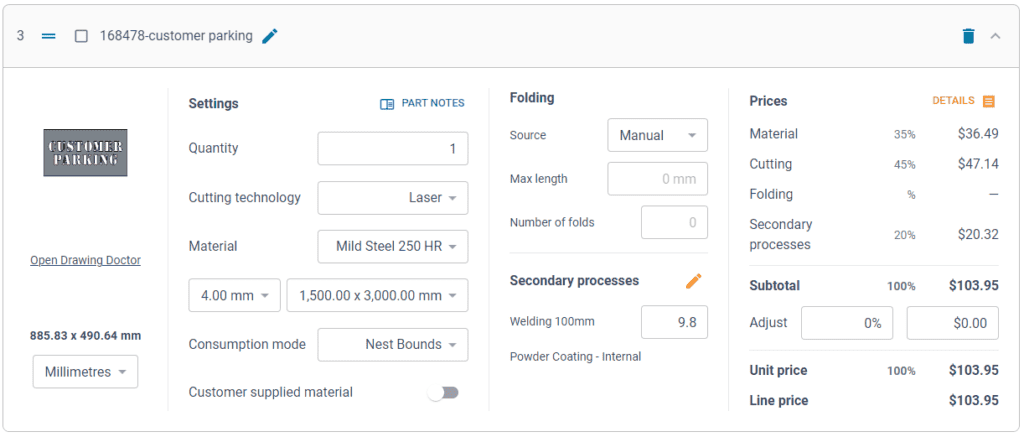
Switching software – overcoming challenges
Even with the knowledge of the benefits of dedicated laser cutting quoting software, job shops can be hesitant about the time involved in switching, says Mark. He notes some of the main concerns:
- Time – often job shops have tried other software implementations and it’s taken months, and they just cannot afford to spend that time again. But Tempus Tools isn’t like other software. For a job shop with one laser, press brake, and standard secondary processes, set up takes less than 90 minutes.
- Staff training – job shops often believe their staff don’t have the time or capacity to learn a whole new software. But again, Tempus Tools is different. It’s designed to be user-friendly, easy to learn, and staff end up doing their jobs more efficiently, and enjoying the features right away.
- Hidden costs – this is a big factor for any software, and job shops are highly alert to cheap upfront costs, followed by lots of add-ons. No one likes to be “nickel and dimed”. For Tempus Tools, it’s a monthly or yearly subscription, and that’s all. No extra charges for support, upgrades, or training. Features all have a set pricing that’s clear from the outset.
- Too many programs – some job shops have two, three, or more different software programs – why add more, especially if they don’t talk to each other? That’s a totally valid concern. Tempus Tools outputs a CSV as standard with all the quote data, making integration seamless and easy.
“The Tempus Tools leadership team has decades of experience working from the shop floor to the top floor, so they understand the pain of changing software, and have designed Tempus Tools to be effortless and simple,” says Mark.
Tempus Tools features
Tempus Tools features that have been specifically designed for laser cutting job shops include:
- 3D model extractor. Identify, extract and unfold sheet-metal parts directly from 3D assemblies without a 3D software package.
- PDF to CAD convertor. Convert a vector PDF into a CAD file instantly. No tracing, no CAD package, just click on a part and extract it into your quote.
- Tube quoting. Easily drag and drop rectangular, square or round hollow sections into the tube module. It quickly calculates highly accurate cutting time and material consumption for pricing.
- Web Store. Let your customers get instant pricing and place orders from your website 24/7 with an online quoting portal.
- Secondary processes. Get accurate and consistent folding prices quickly using the built-in folding algorithm developed by specialists with decades of experience using brake presses.
- Drawing Doctor®. Upon upload of a 2D DXF or DWG file, Drawing Doctor® automatically corrects for double lines, dimensions, and small end points that are hidden in some drawings.
- Part Library. Part Library allows you to save parts that you’ve produced for a customer for re-use. Saves time on repeat orders and quotes, by dropping an existing part straight into the quote, ready to calculate, based on the latest pricing.
“These are just a few of our most popular features, but there are lots more within Tempus Tools, and our development team is constantly listening for customer feedback to determine what new features can be added,” says Mark.
“So for effortless laser cutting quoting, don’t let software hold you back, let it be the catalyst that drives business growth. We offer an obligation-free trial of Tempus Tools so that laser cutting job shops can see the difference for themselves.”
Read blog
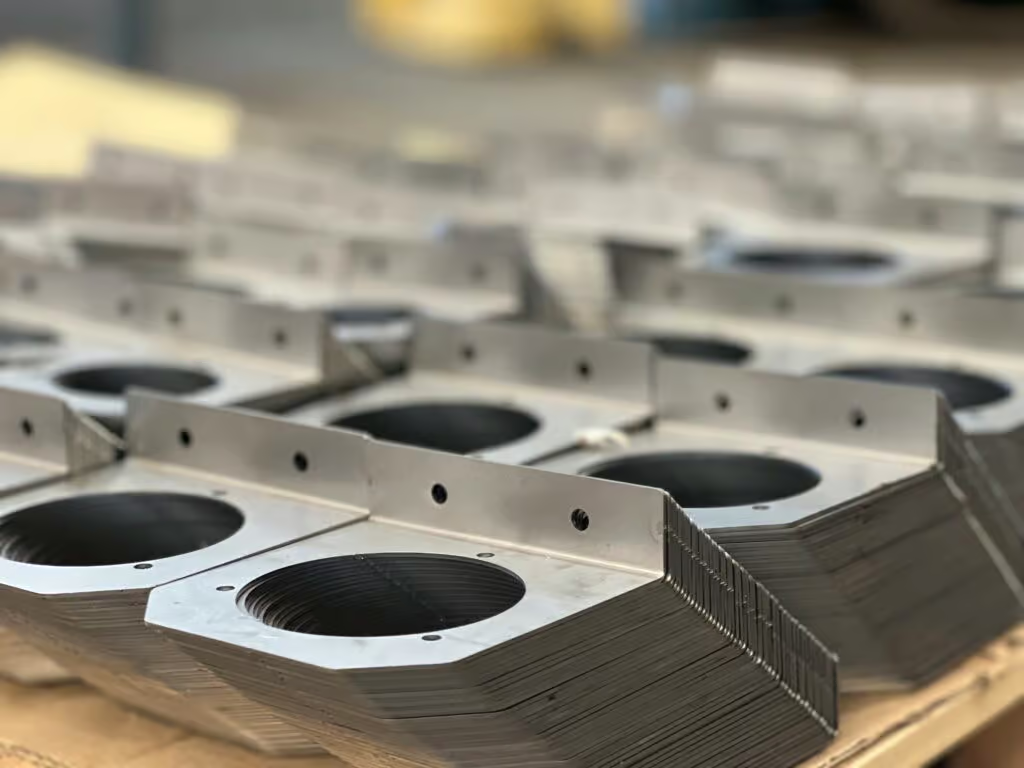
Guides
0
min read
How to set laser cutting prices that are both competitive and profitable
Metal fabrication and laser cutting job shop owners have all asked themselves at one point, “how should I set my prices?”.
It’s a delicate balance. Set your prices too high and customers may walk away to the competition, but set your prices too low, and you may be working too hard for little or no profitable return.
Setting a baseline
“The first thing to do is understand all of the costs that are associated with running your laser machine. Once you have a complete overview, best practice is to apply a full absorption costing method to your business,” advises Bruce Thomas, Product Executive at Tempus Tools. Bruce has decades of experience in the laser cutting industry. His experience is complemented by the Tempus Tools team, which are highly knowledgeable in the laser cutting industry, with practical, hands-on experience on the shop floor, through to management.
“Full absorption costing means that you’re absorbing overhead costs into the hourly rate. In laser cutting job shops, this could be direct costs, like labour, as well as indirect costs like rent, insurance, power, and maintenance. But each case is different, so we can provide guidance on how to perform this type of calculation,” he says.
Bruce explains that once you have calculated all the costs within a job shop and created an annual figure, you can set an accurate yearly revenue target, which can be broken down into monthly and daily objectives. This breakdown is an effective way to focus on revenue goals for the job shop.
“This data should give you an idea of what prices need to be set in order to be profitable, but you won’t know if they are exactly right until you get market feedback, so be prepared to adjust these initial prices,” says Bruce.
A word on assumptions
Full absorption costing is a great starting point, but Bruce points out that this calculation does require some assumptions, such as the number of hours the shop will be operational for, and the percentage of those hours the machine will be cutting (known as the utilisation rate).
“Varying the utilisation rate can have a big impact on how costs are distributed. If your machine isn’t running for as many hours per day as you predicted (actual cutting time), then you find yourself in a situation where you’ve priced your cutting service too low,” he says.
“In other situations, you might increase the number of shifts per day, or add shifts on weekends, which can increase efficiency without changing fixed overheads, resulting in a more competitive hourly rate.
Getting ahead and staying competitive
“Of course, once you’ve come up with a price, it’s crucial to see if it’s competitive with the market, and one of the best ways to do this is to use software to monitor your win/loss ratio,” he says.
“A typical win/loss ratio is about 30-40%. This means, for every 100 jobs you quote for, you win 30-40 of them. Lower than 30 means the pricing is too expensive and you’re losing work to competitors, and above 40 means the pricing is too cheap, meaning you are doing a lot of work for a lower profit margin.”
“It’s important to monitor pricing over time, and see how it changes in reaction to trends, too. For example, material price fluctuations or changes in demand from different industries will have an impact on pricing.”
“Similarly, technology changes will have an impact. Cheaper and more powerful machines, and more automation will allow more advanced laser cutting tasks to be done with lower costs.”
“It’s important to know your customer, but it’s equally important to know your competitor and what they are offering, and for how much.”
Hourly rates only go so far
Much of the metal fabrication and laser cutting industry uses hourly rates to calculate a price, which is then quoted to customers, but this only works up to a point, says Bruce.
“To remain competitive, you need to keep monitoring prices. Each quote – regardless of who prepares it – needs to be consistent and accurate. One of the best ways to do this is to use laser cutting quoting software, so that any changes are implemented within the software, rather than on a per-quote basis,” he explains.
There are a range of factors that can affect a quote, and it can often mean one job shop will quote at a different rate to another. Bruce explains that this can be for reasons such as:
- The speed and size of the machine. A 6kW laser cutting machine can vary from approximately $180,000 to $1,200,000, which is a huge difference. Each machine will perform at different speeds, and allow different levels of sophistication.
- Whether the machine is paid off or not. If it’s still not paid off, this might have to be factored into the hourly rates.
- Cutting thickness, with thicker cuts demanding higher costs.
- Cut quality – all machines will be able to produce an acceptable quality, but some customers may demand an additional level of precision and finish, and if this takes additional time, it will need to be considered in the costs.
“With all that being said, your customer is buying on a per-part basis. They are comparing your part priced at $10 with the competitor’s part priced at $8. So, you need to adjust for this difference using software and data, rather than relying solely on a ‘gut feeling’. Knowing your bottom line gives you the confidence to accept or reject the work,” he says.
Added value wins more jobs
Once you’ve figured out a price, to really stand out from the competition, it’s all about the added value you can deliver, says Bruce.
“Consider your delivery times, customer service, expectations management, and understanding a customer’s unique needs. Do they need all their parts individually packed and labelled, for example? If you can meet their needs, you’re more likely to win the job,” he says.
“Adding value is always better than discounting price. In a race to the bottom on price, nobody wins.”
Tempus Tools helps win more jobs
To help deliver added value, monitor win/loss ratios, and provide faster, more accurate, and more consistent quotes, Tempus Tools created Tempus Tools. Tempus Tools is multi-functional laser cutting quoting software that is calculation-based and runs on a Software as a Service (SaaS) model. It can be set up with information on material price, cutting time, labour, and other relevant information, to generate quotes quickly and accurately.
“Tempus Tools can give job shop owners more accurate estimates of time, which leads to greater consistency,” says Bruce.
“Additionally, Tempus Tools can generate printable part labels, and produce work orders with times listed on each task. Tempus Tools provides consistent and accurate data on folding, cutting, and secondary processes, so that quotes to customers are exactly right.”
“We’ve helped a huge variety of different job shops with full absorption costing, win/loss ratios, setting up pricing, and then generating fast and accurate quotes – so if you’re looking to optimise your job shop’s operations, we’re here to help,” he concludes.
Read blog

Articles
Looking For Laser Cutting Cost Estimating Software? Here’s Why You Should Choose Tempus Tools By Tempus Tools
Tempus Tools helps laser cutting job shops replace slow, inconsistent manual quoting with fast, accurate, rules-based estimates delivered in just minutes. With features like 24/7 Web Store ordering, instant PDF-to-CAD conversion, and over 100 built-in tools, it streamlines the entire quoting workflow so shops can win more work and stay efficient.
To enhance their efficiency and ensure they have more time to focus on the most important aspects of their service, many laser cutting job shops are making use of the laser cutting cost estimating software programs available in the market. By transitioning from manual quoting, these businesses have been able to offer more accurate quotes in a fraction of the time, helping them win more business and meet their production dates.
Nevertheless, it can be difficult to choose from the many alternatives in the market that each have a variety of different features. However, your search for the best solution on the market can stop here, as Tempus Tools beats the opposition every time. Read on to find out more about some of the great features within Tempus Tools by Tempus Tools.
Speed and Accuracy
If your job shop is looking to make the switch to a laser cutting cost estimating software solution, it’s inevitable that you’re looking to improve both the speed and accuracy of your quotes. Therefore, it makes sense to opt for the quickest system within the industry to get the most from your investment and ensure your job shop can win more of the projects that you quote for. Tempus Tools has been carefully developed to ensure it is among the quickest quoting programs in the industry, and this has cut quoting time down to an unbelievable 2 minutes (based on an average quote of 5.5 parts).
The best part is, this streamlined process can be undertaken time and time again at the same efficient rate. Our intuitive job shop estimating software remembers the parts that you have previously quoted for, and uses a systematic approach to ensure consistency across quotes, regardless of the individual completing it. Consistency between quotes is integral to winning big accounts, as it ensures your clients receive the same price for each part they require every time. This helps your clients and your own job shop more accurately calculate your costs and plan for the future, making for fruitful long-term relationships with clients.

24/7 Pricing and Order Placement
One of the most exciting features of the Tempus Tools job shop estimating software is the ability for customers to gain access to accurate pricing information and place their orders at any time of day or night without having to interact with your staff. The Tempus Tools Web Store is the latest feature within the Tempus Tools system, and it allows your customers to place their orders at times that are most convenient to them. This means your job shop can win business without even having to make contact with prospective customers. This allows you to focus more of your time on activities that generate revenue, and waste less time communicating with potential customers that simply wish to hear about your pricing strategies.
The flexibility and immediacy of this laser cutting cost estimating software are of great importance to experienced customers, as this allows them to quickly determine whether your job shop can met their needs within their budget. By offering a transparent system that doesn’t hide additional fees and charges, you’re likely to develop a reputation for honesty and openness, helping you win more jobs in the long run. Importantly, the Tempus Tools quoting software also doesn’t feature any hidden charges such as a hosting fee, or charges for support and upgrades. At Tempus Tools, we pride ourselves on offering an all-in-one digital system with a transparent pricing system, and we make sure you can offer the same transparency to your customers.
Easy PDF To CAD Conversion
All laser cutting job shop owners realise the importance of converting the PDF files you receive from customers into CAD drawings that enable you to edit and interpret all images more easily. However, this process has been too difficult for far too long, and that’s why Tempus Tools allows a vector PDF file to be instantly converted to a CAD file without any tracing. To reduce the time and effort required to produce accurate quotes, the pdf2quote element of Tempus Tools has an easily accessible pop-out window to help the user input the specific part information that they can later refer to.
In addition to inputting information, alterations to the drawings can easily be made by individuals without any experience with CAD, and without needing a CAD software licence, freeing up your specialists to ensure you meet your obligations and satisfy your customers. By creating a laser cutting cost estimating software program that simplifies every element of the quoting process, we make sure you have one less thing to worry about when undertaking each of your projects.
A Rules-Based and User-Friendly System
A huge benefit of the Tempus Tools software is that it operates on a rules-based system that allows individuals from all parts of your job shop to complete quotes, regardless of their expertise. Traditional quoting systems required authorisation and involvement of the manager, as typically they were the only individual with knowledge of pricing structures and policies. With Tempus Tools, you can wave goodbye to the days of continual managerial approval and maximise your efficiency, because a short introductory training program is all that’s required to get your frontline staff involved in the quoting process. This makes sure you can tend to your customers’ needs quickly and irrespective of how busy your quoting specialists are, ensuring you offer a high level of customer service in every interaction.
Our user-friendly system makes sure your highly skilled laser cutting specialists aren’t called on to produce quotes, helping your job shop steer clear of one of the most common reasons for delays in production. You’ll never need to simulate jobs to deliver quotes again, and keeping programmers away from the quoting process helps you save money and maximise the expertise of your specialists, keeping them focused on production.
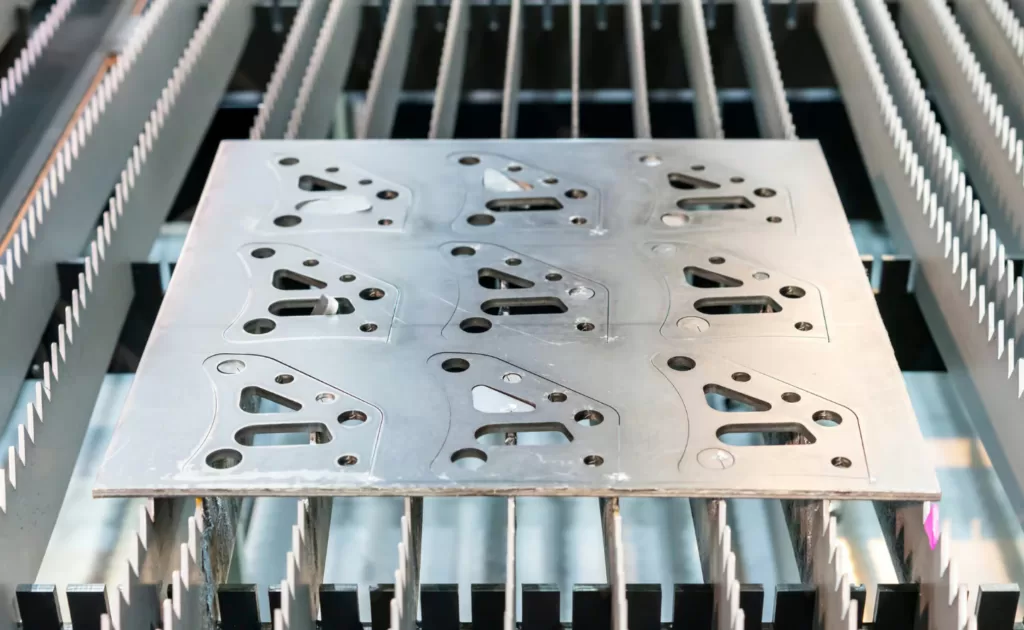
Streamline Your Laser Cutting Quoting Process With Tempus Tools
With more than a century of combined experience in the laser industry amongst our leadership team, our intimate knowledge of the industry has offered us a great understanding of both the challenges and opportunities our customers face.
We understand that no two job shops offer an identical service, and they each have different challenges to address. This has shown us that a one size fits all approach does not work, and that’s why Tempus Tools has over 100 different features – all included – to suit the different needs of different job shops.
We’re passionate about designing innovative quoting solutions that help laser businesses operate as effectively and efficiently as possible through the realisation of technology. We have a team of dedicated and highly skilled professionals that share a desire to deliver positive results for our clients and their customers. This has enabled us to develop the most essential tools that every single laser-cutting cost estimator should have access to.
At Tempus Tools, we offer job shops an easy-to-use digital tool kit that ensures you can quickly calculate and prepare accurate and consistent quotes. Don’t waste your valuable time spending hours manually creating quotes. Make the most of your time and instead create your quotes in under 2 minutes with Tempus Tools.
Start your Trial today!
If you’d like to find out more about Tempus Tools’ job shop estimating software that is a cut above the rest, contact our friendly team!
Read blog
Guides
Tips For New Laser Owners
Running a profitable laser cutting machine starts with knowing your true costs—materials, nitrogen, wastage, maintenance—and using accurate quoting to price work correctly. Tempus Tools helps new and growing job shops quote in minutes, stay consistent, and maximise return on their machine investment.
So you’ve just bought a new laser cutting machine… what next?
A laser cutting machine is a big investment. Depending on the features included, they can be north of $1 million, so you want to be gaining maximum value from your investment. But how do you know what to charge? What are your expenses vs your hourly rate? For new players, it can be hard to know where to start.
Top tips for laser cutting machine owners
Firstly, if you want to maximise the return on your laser cutting machine, make sure you have a fast and accurate laser cutting quoting software in place (more on this later), but first, here are some of the considerations when setting up parameters with your quoting software, to customise it to your job shop:
1. Calculating cost.
I’d recommend using the “full absorption costing” method. This is a managerial accounting method that considers all the costs associated with manufacturing a particular product. There are direct costs, like materials and labour, and indirect costs like rent, insurance, power, and maintenance. Basically, you want to cover everything it takes to run the machine when calculating your hourly rate.
2. Factoring in the cost of Nitrogen.
This one is so easy to overlook, but if you’re cutting materials like stainless steel, you’ll probably use something like a 3mm nozzle with 20 Bar of Nitrogen. For thicker cutting jobs, it can cost $70-$80 per hour for the Nitrogen alone! If that isn’t included in your hourly rate, you may not end up making a profit on some jobs but costing money to do the work. You know that bad feeling when you win a big job, and you think, “I wonder if I’m making money on this?”
3. Factoring in material wastage.
This is unavoidable – it’s all about minimising waste, accurately calculating the percentage of waste, and making sure you’ve charged for it. Even in an ideal setup with 100x100mm x10mm square nested parts, you’ll need to have 10mm around each part, and 10mm around the edge of the metal sheet, which equates to about 21-22% material wastage, which can’t be beaten. Other shapes will likely have a higher percentage of wasted material, so you need to include this in your laser-cutting quotes to customers.
In the example below, we have taken a 3000mm x 1500mm sheet, with nested square parts of 100mm x 100mm each. This gives 27 parts per row and 13 per column, with a total of 351 parts.
The top diagram shows these parts with 10mm around each part, as well as 10mm around the edge of the sheet.
The bottom diagram shows this same sheet if all parts were common line cut– with the grey part visually showing the total material wastage. In this example, it is approximately 21.37% material waste. (Now imagine if the parts aren’t squares, and don’t sit so neatly together…)

4. Don’t forget the cost of maintenance.
Every machine will experience wear and tear over time and will need some sort of maintenance or consumable parts replacement to keep it running at optimum efficiency. You might remember to do this, but did you factor that into your hourly rate and your laser cutting quotes? If you do this from the very start, you build up a buffer, so that if something does go wrong, you have charged sufficient money to cover those costs. It may not be next week, but over the machine’s lifetime, it’s bound to happen eventually.
5. Get the setup right.
And don’t let the installation technician leave until it’s right. You want to make sure they set up the technical tables correctly before they leave. If these tables are based on “laser plate” (a material made to cut on a laser, and has very good cutting parameters), the technical tables won’t be accurate if a different material is used. As they are setting up the machine, ask them to show you how to upload parts, nest them, and then cut – record this! It’s the most useful thing you can do. You can customise it through a huge range of settings these days, but for the overwhelming majority of jobs, this is all you need to do.
6. Fix machine issues before playing around with the settings.
If a laser cutting machine isn’t working the way it should, the temptation is always to adjust the settings until it does what you’d like it to do. But that machine should provide the right output without adjustments – and if not, it’s a sign something needs to be fixed. As a general rule, you should not adjust the feed rate more than 5% either way. Another big temptation will be to slow down the feed rate when cutting stainless steel – this can actually make it worse.
Laser cutting quoting software – make the most of your machine
Once you’ve got all your set-up completed, and you’ve understood the full absorption costs of your machine, it’s time to figure out how you’ll get quotes out to your potential customers to win business and grow your job shop.
30 minutes or less quotes should be a bare minimum these days, but there are much faster methods out there. Sheet metal estimating software has come a long way in recent years, and it can make the difference between a job shop just meeting demand, and a job shop being able to grow and expand. If your job shop is not an expanding business or doesn’t have room for growth, then all you did is buy yourself a job.
Using a cloud-based laser cutting quoting software like Tempus Tools, an average quote (5.5 parts) takes just two minutes! That’s 15 times faster than the industry average, which is around 30 minutes.
And quotes developed within Tempus Tools are accurate and repeatable because all the data is saved, ready for the next quote. No more problems with inconsistent pricing, or errors from miscalculations. And, if the price of materials changes, for example, simply change this within Tempus Tempus ToolsToolsTools, and it will automatically update the quote.
As a job shop, you want to spend most of your time using your machine to fulfil orders. You don’t want to spend half your day developing and responding to a Request For Quotes (RFQs) – especially when the typical win rate is about 30-40% of all jobs quoted for.
Tempus Tools features
- Quick and easy set up (typically under 30 minutes)
- Easy to use – no specialised skills or training required
- No CAD or CAM programs or expertise required
- Integration with Xero, Quickbooks and available on the AutoDesk app store
- Extract and unfold 3D parts at the click of a button
- Fix drawing errors and export cleaned DXF or DWG files
- Folding Calculator, which is rules-based with your parameters
- Unlimited secondary processes
- Multiple cutting technologies …and other features designed to save you time
If you’re looking for a rules-based, front-end, sales-focused laser cutting quoting software, Tempus Tools could be the ideal solution to help grow your business.
Try Tempus Tools for free for the first 14 days to see just how easy it can be.
About the author
Bruce Thomas is Product Executive at Tempus Tools. He began his career in the laser industry in 1971, and has worked for a major laser machine manufacturer, then helped set up and run new job shops, before becoming CEO of a major Laser job shop with multiple sites throughout Australia, a company with 11 laser cutting machines. Bruce’s practical, hands-on experience in the industry has helped guide his contributions to Tempus Tools, as he steers product development to ensure the laser cutting quoting software provides features that job shops will gain the most benefit from.
Read blog

Articles
Types of Sheet Metal Estimating Software Available on the Market
Sheet metal quoting can be slow and complex, but cloud-based estimating software offers the fastest, most accurate path—letting shops quote from 2D or 3D files with minimal effort. Tempus Tools delivers this all-in-one approach, helping job shops create consistent quotes in minutes and win more work with ease.
Sheet metal estimating and quoting can be a very time-consuming task, which can play a role in determining a job shop’s profitability.
Have you found it difficult to respond to a customer’s Request For Quote (RFQ) quickly? Do you want to find a solution to minimise the necessary administrative steps when it comes to estimating and quoting?
Many businesses are now finding success in utilising automated sheet metal estimating software to respond to an RFQ efficiently and accurately.
There are various types of sheet metal estimating software that you can find on the market. So what is the best and most efficient practice for your job shop?
We’ve made it easier for you with a guide to the various types of software you can purchase, and how they work.
4 Types Of Sheet Metal Estimating Software
Computer-Aided Designing (CAD) Software Add-Ons
Skilled engineers may be comfortable working with 3D CAD models or 2D CAD files. CAD software does come with options for estimating, but they require a high cost of investment in terms of software, training, and labour.
A 2D software licence is required for all CAD work, and then 3D is an add-on to work with 3D models. Even once this is all set up, the user still has to identify which parts to develop, ready for estimating.
Producing an end quote can sometimes be a bit tricky due to the fact that margins need to be set and a majority of CAD software does not allow for the use of building sheet layouts and nestings. Therefore, in most cases, the accuracy can be very restricted.

Computer-Aided Machining (CAM) Software (As An Add-On)
CAM software is based on a specified process, such as laser cutting. Quoting CAD files for laser cutting using CAM software requires utilising the established plans of the machines as a rule for the total time and material, which is calculated into an end price. Such quoting is in need of a lot of direct work and is only focused on a particular processing operation at a time. Quoting CAD files for laser cutting with CAM software can sometimes lead to an overly complicated excel sheet that is unable to be integrated into the entirety of your business.
The solution to quoting CAD files for laser cutting with CAM software is to incorporate an add-on on top. This way, you are able to add multiple additional processing steps, and it provides you with the ability to export your quote from the software directly to the customer. But this is an expensive way to arrive at this solution.
Allocated On-Premise Quoting Software
Another system for quoting sheet metal parts from a 3D model is to use a dedicated on-premise quoting software. This is similar to CAM software and is designed to provide a quote estimation of various working steps. It provides a comprehensive solution regardless of the type of machine you are using. The software bundles offered within such software are customisable and configurable.
On-premise quoting solutions typically require a larger upfront capital investment, and staff usually need to be experienced in how to customise and configure the software. The business is also responsible for cybersecurity, which is becoming an increasing concern, as cyber criminals increase their attacks globally. In contrast, a cloud-based solution provider would handle all the customisation, configurations, and security elements.

Online Quoting Software (Cloud-Based)
When quoting sheet metal parts from a 3D model or 2D file, an online cloud-based quoting software is very beneficial. This type of sheet metal quoting software can minimise errors and offer precise quotes and prices to customers instantaneously.
It can also authorise customers to receive quotes for customised orders without the need to stand by for a sales rep’s response. This method can allow a customer to upload their 3D model or 2D CAD file, along with the specialised product requirements. A CAM software will then examine the necessities of the product and then calculate the price.
Quoting online has been a very popular and successful way to attract new customers as well as reaffirm business for metal fabrication companies.
Tempus Tools: Your All-In-One (Cloud-Based) Laser Quoting Solution
Streamline your laser cutting quoting process with Tempus Tools’ sheet metal estimating software!
With 100+ years of combined experience in the laser industry, our deep industry knowledge and expertise have provided us with a true understanding of both the challenges faced and the opportunities available for our customers.
We understand that each job shop operates in its own way and has different challenges to address. We know that one size does not fit all, which is why Tempus Tools has over 100 different features – all included – to suit the different needs of different job shops.
We’re passionate about designing innovative solutions to see laser businesses running as effectively and efficiently through the realisation of technology. Our team of highly skilled professionals have a shared desire to deliver positive results for our clients and their customers. This has allowed us to develop the essential tools that every estimator should have access to.
Tempus Tools offer job shops an easy-to-use digital tool kit to help you quickly calculate and prepare accurate and consistent quotes. Don’t waste your time spending hours creating manual quotes. Reduce it to quotes created in under 2 minutes with Tempus Tools.
Start your trial today! Plus, to find out more about Tempus Tools’ sheet metal estimating software that is a cut above the rest, contact our friendly team!
Read blog

Guides
5 Features Of A Good Quoting System
Automated sheet-metal quoting works best when the software is fast, flexible, integrates with your existing systems, and handles any file format with consistent, standardised pricing. Tempus Tools delivers all of this, helping job shops quote in under two minutes and win more work with accuracy and speed.
Automated sheet metal quoting is based on the data present within a 3D CAD model, combined with user-inputted, non-geometric information. It cross-examines the model in order to withdraw geometric data that is applicable to sheet metal manufacturing, such as the number of bends, the thickness of the material, and the length of the cut.
With state-of-the-art technology and updated software improvements, quoting components and systems, it can aid in making it simple and effortless for jobshops to win quoting contracts and increase their acquisition margin. When searching for a sheet metal estimating software to implement within your business, your jobshop should research and take into consideration various factors and characteristics to guarantee that they are receiving a suitable system for their manufacturing obligations.
Below are five key features to look for in a good sheet metal estimating system.
Expandable Options
One of the leading attributes of a sheet metal estimating software is its capability to determine quotes. No matter if it is for small to medium-sized enterprises or larger, more sophisticated multi-machine operators, there are various options available to enhance a fabricator’s bottom line.
As a jobshop grows, it may need to suddenly increase the number of quotes it produces in a day.
In order to select a valid quoting software plan, fabricators should not limit themselves. They should think of the prospective time ahead if there are anticipated areas of expansion where a more expansive plan would prove to be more compatible with the business.
Win Quotes With Speed
Tempus Tools’ CEO, Ivan Cooper, states that winning a customer’s first quote is crucial to business growth. “If you’re winning less than 40% of all jobs quoted for – which is standard for jobshops – an effective way to grow the business is to reduce the time it takes to produce each quote. Our data shows that the average number of line items is 5.5, and the average time per line is five minutes and 30 minutes per quote”.
Fabricators do not have the time to spend hours creating manual quotes. A process that takes generally takes 30 minutes or more when creating quotes can be minimised to under 2 minutes. Using Tempus Tool’s software as a front-end sales tool, an average quote of 5.5 parts takes just two minutes – that’s 15 times faster, and it’s totally repeatable every time. The more efficiently you can get a quote to a customer, the more likely you are to win the quote.
CAD/CAM or MRP/ERP Integration
Direct integration with a CAD or CAM system can prove to be very beneficial for any fabricator. It can supply jobshops with an added need to adjust drawings for more accurate quoting.
An integrated sheet metal estimating software can incorporate countless functionality. Since not all drawings are clean and precise, direct integration allows fabricators to utilise tools with the ability to change line types or layer types, adjust exact geometries or even identify open endpoints.
Further, if your are already using a CAM/CAM or MRP/ERP system, you want your quoting software to be able to talk to your existing software to create a seamless integration.
Wide-Ranging File Formats
Selecting a sheet metal estimating software that has the capacity to import any type of file is a big plus. The last thing any shop wants to do is go back to the customer and state to them that the file they have supplied them with is unable to be opened, ultimately prohibiting the shop from quoting the project.
From 2D files like DXF and DWG, to 3D files like STEP, SLDPART, IPT, and IGES there are many different file formats that jobshops are expected to handle. A good quoting system should be able to import any type of file format without any issues.
Standardised Quoting Methods
Without the use of a quoting software, workers will have their own ways of quoting and looking at numerous metrics and parameters to calculate the costs of different jobs. This can result in discrepancies and quoting fluctuations, as well as no regulated way to track how various quotes have been handled. This can make it very hard to forecast costs and estimate profit margins.
Sheet metal estimating software should ideally be automated and standardised. Fabricators are able to get the same quote each time as the calculations, costs, markups, production metrics, and all applicable data is available for the system to quote a project properly. No matter who is using the software, it offers the jobshop peace of mind in utilising best business practices.
Streamline Your Laser Cutting Quoting Process With Tempus Tools’ Sheet Metal Estimating Software!
With 100+ years of combined experience in the laser industry, our deep industry knowledge and expertise have provided us with a true understanding of both the challenges faced and the opportunities available for our customers.
We understand that each jobshop operates in its own way and has different challenges to address. We know that one size does not fit all, which is why Tempus Tools has over 100 different features – all included – to suit the different needs of different jobshops.
We’re passionate about designing innovative solutions to see laser businesses running as effectively and efficiently through the realisation of technology. Our team of highly skilled professionals have a shared desire to deliver positive results for our clients and their customers. This has allowed us to develop the essential tools that every estimator should have access to.
Tempus Tools offer jobshops an easy-to-use digital tool kit to help you quickly calculate and prepare accurate and consistent quotes. Don’t waste your time spending hours creating manual quotes. Reduce it to quotes created in under 2 minutes with, Tempus Tools.
Start your Trial today!
Plus, to find out more about Tempus Tools’ sheet metal estimating software that is a cut above the rest, contact our friendly team!
Read blog
Guides
Is Your Brake Press Breaking The Budget? Save Costs And Operator Time With Front-End Quoting
Brake press operators are expensive and hard to find—so pulling them away from production to help with quoting wastes valuable time and slows the whole shop down. Tempus Tools lets anyone create fast, accurate quotes in minutes, freeing skilled operators to stay productive while the business wins more work.
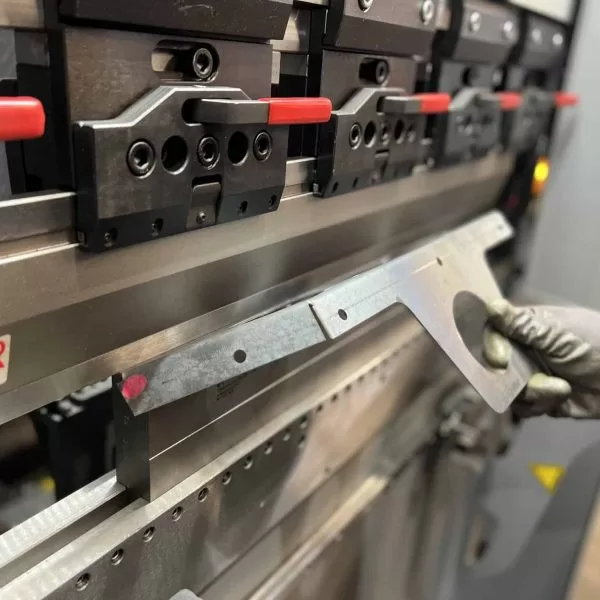
Most laser job shop owners will agree that a brake press operator is one of the most expensive people in the jobshop – and is often the hardest to find. With bending being an essential component of most job shops’ processes, having the right brake press (and operator) is a must.
So, if you’ve finally found a qualified brake press operator who is a good fit for the business – the worst thing you can do is take their valuable time with quoting and estimating tasks.
Instead of having a brake press operator (or CAM specialist) prepare quotes, or perform the calculations necessary to generate an accurate and repeatable quote, use a front-end laser cutting quoting software like Tempus Tools.
Typically, the brake press is situated at the back of the factory because this makes sense with a lot of workflows. So, if a customer service person needs to take a long walk to get input from the brake press operator for every quote, that’s two people’s time consumed in the quote preparation process.
With Tempus Tools, anyone can prepare a quote lightning fast, meaning qualified staff can perform the tasks they are trained in, and the business can respond to more quotes, win more quotes, be more efficient on the job floor, and drive growth.
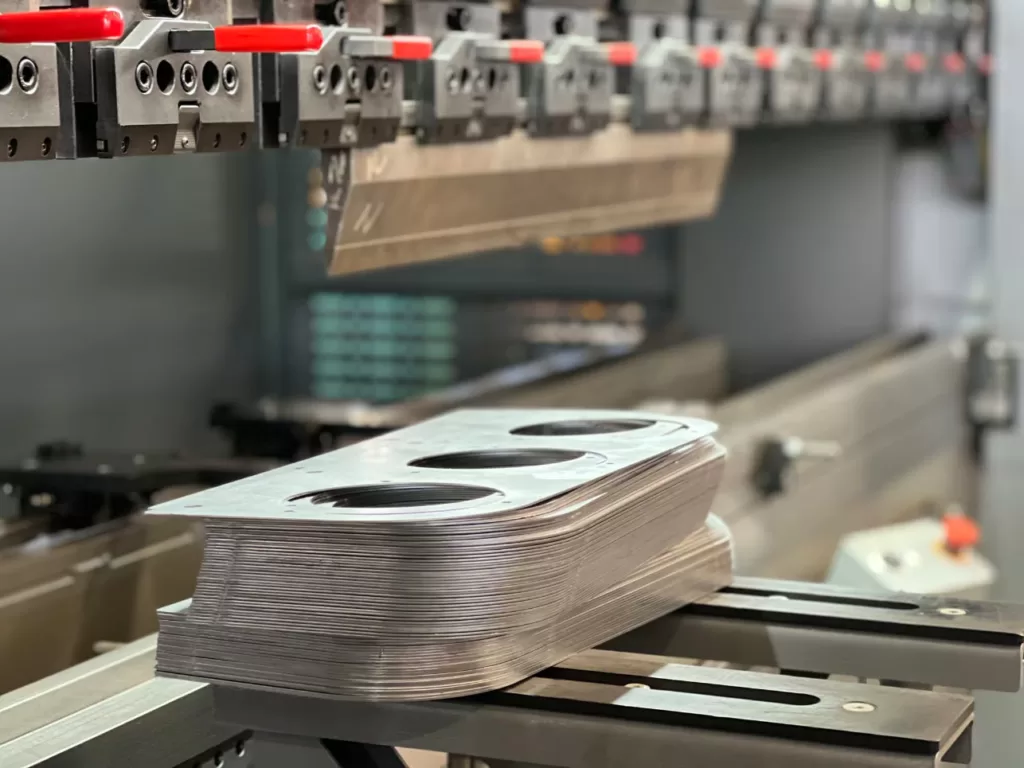
The Laser Estimator’s Time-Saving Tempus Tools
Tempus Tools generates repeatable, consistent quotes, typically in less than two minutes.
Our data, based on more than 1,000,000 laser-cutting quotes, shows the average number of line items is 5.5, with an average time of 5 minutes per line or 30 minutes per quote.
Using Tempus Tools as a front-end sales tool, an average quote of 5.5 parts takes just two minutes – that’s 15 times faster, and it’s totally repeatable every time.
Tempus Tools has a range of other useful features, too, including unfolding 3D parts, secondary processes support, folding, tube, a part library for fast repeat quotes, and more!
Try Tempus Tools for free for 14 days to see how much time and cost it could save your business.
Start Trial – first 14 days free
Choosing The Right Brake Press
For laser job shops, how do you know which brake press is right for your business?
Every setup is unique, but as a general rule, the first brake press should be as large and flexible as possible. This is likely 3m since most laser beds are 3m long. The tonnage will be determined by the power of your laser because this will determine how thick you can cut.
For your second press, you can optimise its size to accommodate most of your work. In this case, typically, a small 1m 50t press could be enough for about 80% of your work, with the larger press handling the bigger jobs.
Our advice for new players is not to buy two 3m presses unless your work specifically requires it. This will be an added expense and take up more floor space without offering your job shop any additional benefits over the smaller press.
On top of this, with energy prices soaring across the globe, a larger brake press will consume more energy, adding to a jobshop’s costs and environmental footprint.
Read blog

Articles
Inefficient quoting is holding back jobshop competitiveness
Most job shops struggle with slow, inconsistent quoting because they’re relying on production software, spreadsheets, or generic ERP tools that were never designed for sales. Tempus Tools solves this by giving shops a fast, industry-specific quoting system that anyone can use, helping them send more quotes, win more work, and grow faster.
Industry-specific, sales-focused quoting software means you spend less and sell more
Most laser, plasma, waterjet, oxy cutting, folding (and secondary processes) jobshops are using inefficient estimation methods, because they are not aware that industry-specific software exists.
The lack of a streamlined and inexpensive estimating procedure may be one of the biggest roadblocks for jobshop growth, because the inability to send accurate and timely quotes (at a low cost) prevents companies from selling more, increasing production, and expanding the business.
But it doesn’t have to be that difficult.
Let’s take a look at the biggest quoting problems jobshops are facing, and how an industry-specific sales-focused quoting software can boost competitiveness and foster business growth.
The problem with non-specific software
Different types of software provided by machine manufacturers, or CAM software, are excellent production-focused tools… but they are not sales software. They haven’t been specifically designed so that you, as a jobshop, can quote quickly, quote accurately, and maximise the number of quotes you win.
A typical estimation and quoting process using these types of software (or worse, a spreadsheet with all the information stored in one person’s head!) often encounters the following roadblocks:
- A heavy reliance on the manager or owner for quoting, because only they know the pricing policy and what discounts can be applied
- Difficulty keeping up with sheet price changes
- High risk of not bidding on larger jobs because of the complexity of quoting. This could be because of:
- Too much time needed to quote
- Shared resources (labor/software) for estimating and production
- Multiple drawings
- Multiple materials
- Multiple secondary processes
- Multiple estimation stages, which means:
- More resources are involved
- Highly skilled labor is required
- High cost of software licenses needed
- Higher error risk (multiple points of information processing and information circulation)
- Longer processing times
- Higher risk of delivering late quotes
Here’s how a typical quoting flow looks like with these systems in place:
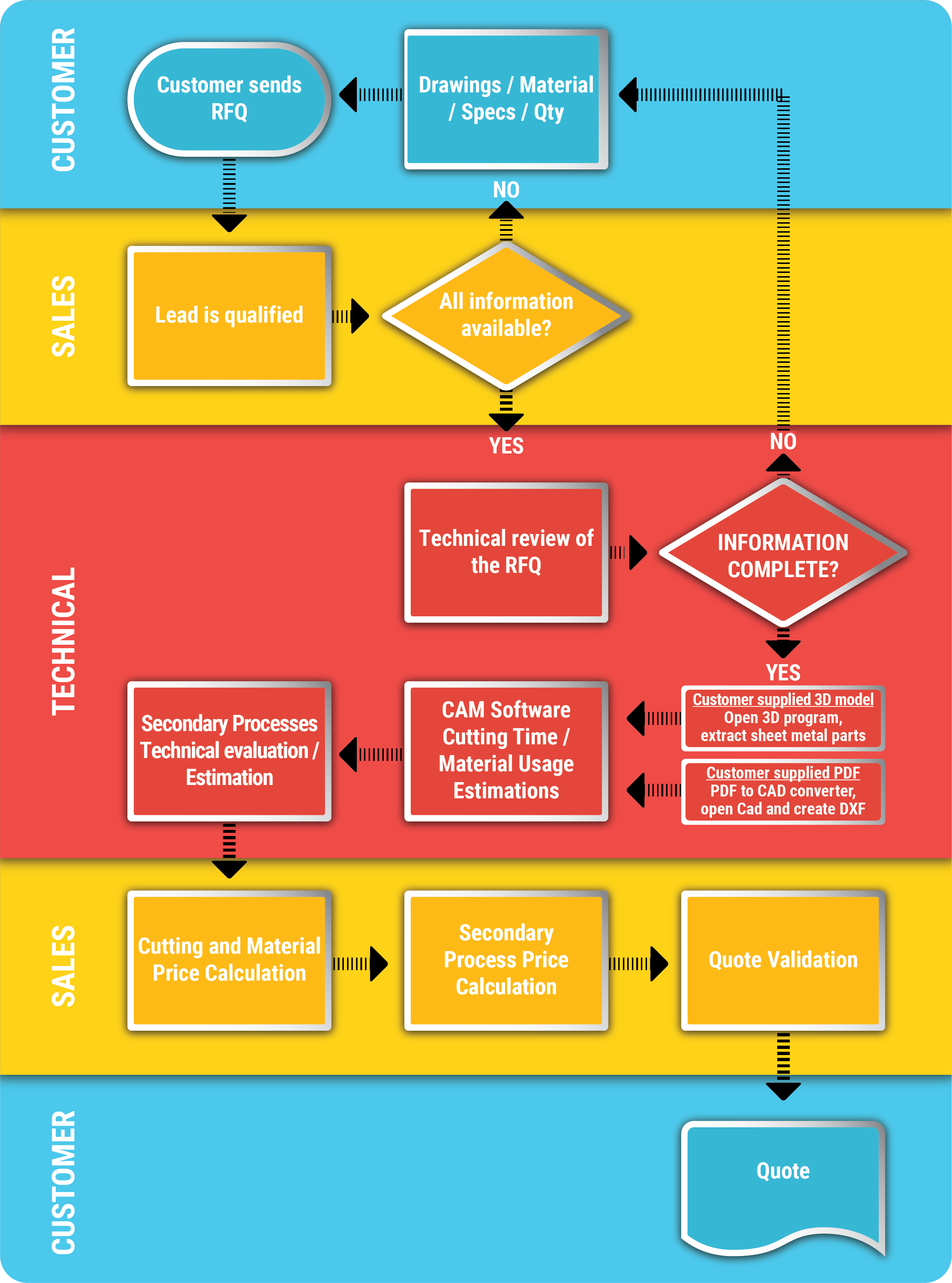
Typically, only 30-40% of jobs quoted are won, meaning that a large portion of the estimating cost is lost, lowering the company’s competitiveness.
Inefficient estimating means that jobshops buy more CAM software licenses and employ more highly skilled labor than they really need.
Production software isn’t efficient for jobshop quoting
Laser machine manufacturers focus their software on production, because that’s what’s required to run the machines. So, when quoting is added to this software, it’s often difficult to use. You may notice:
- The software is designed to be used by experts such as designers and machine programmers
- There is no automated drawing cleaning – you’ll have to do this yourself
- 3D assemblies are processed manually on a 3D software package for 2D parts extraction
- Only output time and material usage are included – no pricing
- Most secondary processes (powder coating, tapping, mig welding and a range of others) must be estimated on a different software, spreadsheet, or done manually.
But what about ERP or CPQ systems?
Some jobshops see the inherent weaknesses in the production-focused software, and the next option is to explore Enterprise Resource Planning (ERP) or Configure Price Quote (CPQ) systems.
These systems have their advantages, but they fall short when it comes to providing quotes as a sales tool, to grow the business. This is because, with ERPs and CPQs:
- There are no standard quoting modules
- There are no industry-specific business rules
- Costly workarounds are regularly required to accommodate cutting, material, and secondary processes in quotes due to the standardized characteristics
- Quotes do not include thumbnail drawings of the parts (simple point of error detection by customers)
Laser / Plasma / Waterjet / Oxy cutting (+ Secondary processes) quoting should be done in an estimating-specific software, not on an array of production, spreadsheets and generic ERP software packages that add cost and stifle efficiency.
Where can I find industry-specific sales focused software for jobshop quoting?
You’ve come to the right place. Tempus Tools, has been designed as a sales software. It is a customer-facing solution that has been designed to help jobshops sell more.
Not only is it a sales software, but Tempus Tools is rules-based, which enables lesser skilled customer-facing service staff to prepare and issue quotes. This means it’s not taking highly qualified CAM specialists and brake press operators away from their productive tasks to assist with quote preparation.
Tempus Tools has all the tools a jobshop needs to get more quotes to customers, win more jobs, and grow the business.
Remember that convoluted and long quoting flow diagram from earlier? Here’s how it could look with Tempus Tools:
Tempus Tools sounds interesting – how do I know if it’s right for my jobshop?
The best way to see if a software works for you, is to try it. If you have a laser, plasma, waterjet, or oxy cutting machine, we believe Tempus Tools can save you time and win you more business.
To prove this to you, we are offering a no-obligation trial where you can try Tempus Tools for free for the first 14 days.
Read blog


ROI Calculator
See how much time and money you’ll save
Use our ROI Calculator to measure potential labor savings, faster quoting, and increased consistency for your shop.

Resources
Success stories

Success stories
0
min read
US job shop Hammers home success with attitude-first hiring
Facing skilled labor shortages, Hammer MetalWerks shifted its hiring strategy to prioritize attitude over experience, using technology to quickly train new operators. With Tempus Tools streamlining quoting, work orders, and secondary processes, the team has improved accuracy, reduced errors, and empowered new staff to become productive faster.
A US-based metal fabrication job shop is taking a new approach to hiring staff, in response to skilled labor shortages, preferencing work ethic and attitude over existing skillset.
Derek Hammer, President of Hammer MetalWerks, and Erin Hammer, Vice President and Director of Human Resources have found that with the right technology, you can train and upskill an employee with a good attitude, which benefits them and the business.
“Our laser operator and brake press operator had both never used those machines in their life before working here. But they were intelligent, familiar with computer systems, and had a positive attitude to learning, so we hired them based on that,” said Derek.
Hammer MetalWerks provides small-to-medium production runs and parts for a huge range of industries, from construction, to healthcare, entertainment, attractions, military, and government.
“Rather than looking for highly skilled – and more expensive – operators, which are in short supply, we looked for technology that could make the operator’s job easier, and help them get up to speed faster,” says Derek.
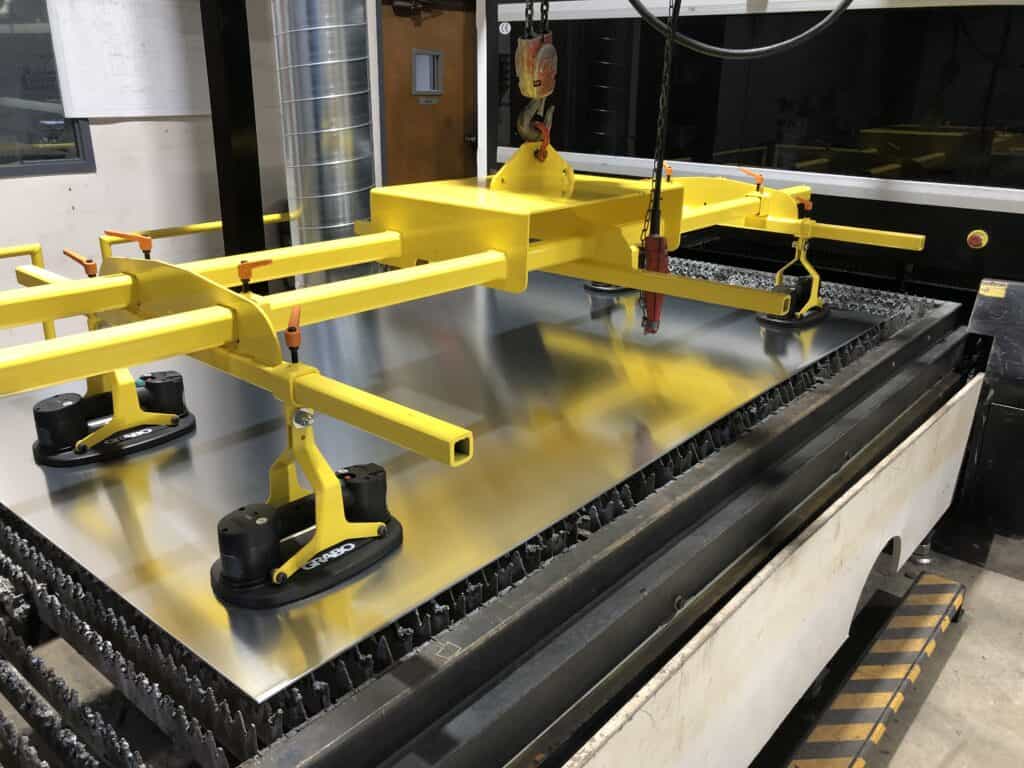
Hammer chooses Tempus Tools
One technology the Hammers chose to help their new staff, and the overall efficiency of the job shop, was Tempus Tools. Tempus Tools is multi-functional laser cutting quoting software that is calculation-based and runs on a Software as a Service (SaaS) model. It can be set up with information on material price, cutting time, labour, and other relevant information, to generate quotes quickly and accurately.
“Tempus Tools has been highly valuable for us. It provides work orders to the shop floor with lots of details that the operators don’t have to find or calculate themselves. One example for us is that sheet sizes are all metric, and we use imperial gauges in the US – which can often lead to errors if not converted correctly,” explains Derek, whose business operates a 3kW fiber laser machine.
“Moreover, 11 gauge aluminium is not the same thickness as 11 gauge steel, and our laser machines are all metric, so having all the right measurements through Tempus Tools reduces the risk of any errors.”
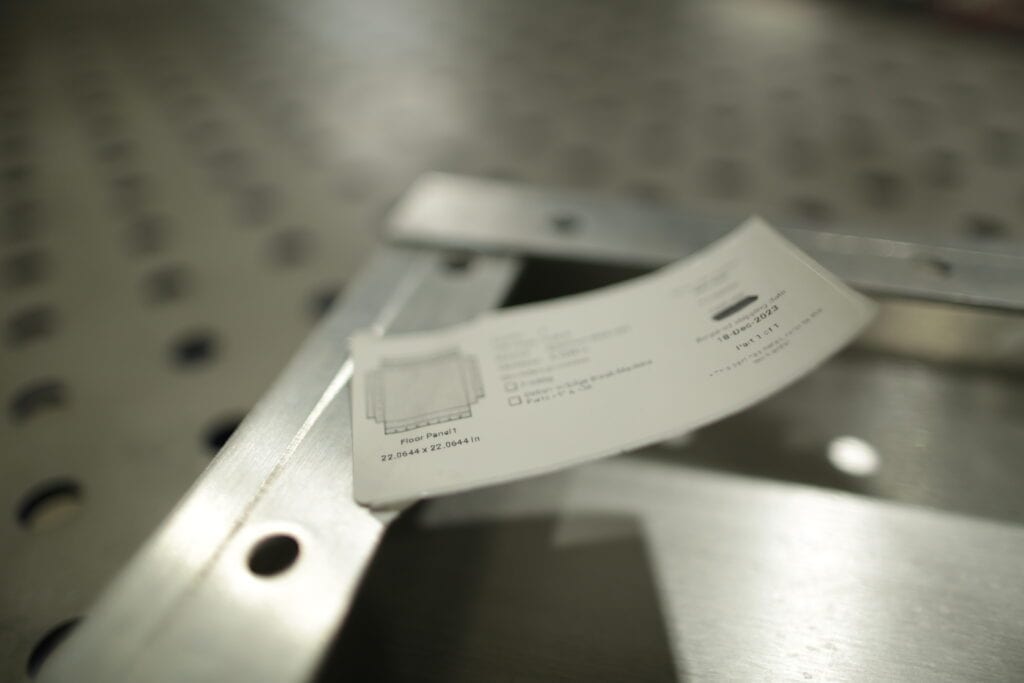
“Additionally, Tempus Tools is very user-friendly, so staff that are used to working with computers in a broad range of contexts can pick up the program quickly and begin working with it.”
Tempus Tools CEO, Bart Jesman, says it’s rewarding to see the software benefitting forward-thinking job shops like Hammer MetalWerks. “We’ve designed Tempus Tools to provide benefits to job shops of all shapes and sizes. What Derek has done is take this a step further and used it to improve his hiring process, by making the operator’s job easier – it’s an intelligent approach.”
Secondary processes
In addition to metal fabrication and laser cutting, Hammer MetalWerks has a unique advantage over most job shops, with the broad range of additional services and secondary processes it provides, including design, bending, welding, powder coating, packaging, tapping, rivets, hardware, and more, all from the one place.
“With so many secondary processes, it’s so helpful that we can quote them all using Tempus Tools, and they can all be included in the work order that goes out to the shop floor,” says Derek.
“Additionally, the work order can be sent to our label printer, including a thumbnail of each item, to provide a visual cue to our shop floor staff, to further enhance the accuracy and efficiency of their work. It really helps avoid mix-ups on the shop floor.”
Updates and support
Derek adds that the support from the Tempus Tools team has been outstanding, collaborative, and helpful.
“The Tempus Tools team is always open to feedback, and they use this to help develop new features that make Tempus Tools better for job shops like ours. But they’ll also help with general questions we have – and they have experienced staff to draw upon for industry knowledge,” he says.
“With the skilled labor shortages in the US – and common issues around the world – having the right technology is crucial. We now hire employees that fit well with our work culture and have a good attitude – and it’s working out well for our business,” concludes Derek.
To learn more about Tempus Tools, please click here.
Read blog
Success stories
0
min read
From quoting crunches to streamlined processes: Tempus Tools empowers growth of J&T Steel Sales
As J&T Steel Sales expanded into the fast-growing laser cutting market, outdated spreadsheet-based quoting quickly became a bottleneck for delivering fast, reliable service. By adopting Tempus Tools, the team streamlined quoting, order tracking, and invoicing—freeing up time, improving consistency, and supporting the company’s growth as they scale their laser cutting operations.
Expanding Australian metal fabrication specialist, J&T Steel Sales, has found that improved productivity and new equipment is only half the battle to boost customer service and sales – equally important is eliminating the outdated processes used to track and prepare quotes, delivery, and invoices.
J&T Steel Sales began as a small plate processing business in Victoria with a CNC Plasma machine, where staff used spreadsheets to develop quotes for customers, but the company has now made the move into the high demand laser cutting market.
Part of the motivation for the expansion was a need in the market for better lead times on laser cut metal products, including aluminium, stainless steel, and carbon steel.
“We had customers come and beg us to purchase a laser machine, because they were fed up with the long lead times that were becoming increasingly common for laser cut products,” explains Luke Patterson, Operations Manager, J&T Steel Sales.
“So we invested in a laser cutting machine, and prepared to grow our business to the next level. But with this change, we needed a quick and efficient software solution to export a presentable quote that we can forward directly to customers in a timely fashion. Spreadsheets just weren’t going to work anymore, so we did some research and found Tempus Tools,” he said.
Laser cutting quoting software streamlines operationsTempus Tools, is a multi-functional laser cutting quoting software that is provided using a SaaS (Software as a Service) model. Tempus Tools was developed specifically for the laser cutting industry, and is designed to save job shops time, and make quoting more efficient, accurate, and consistent.
“Tempus Tools has allowed us to streamline not only the quoting aspect, but also the tracking of active orders as well as invoicing,” says Luke.
“It has been able to take most of the heavy lifting in cutting back on excess paper waste in our offices, whilst also creating a digital paper trail to be able to track material usage and stock.”
Since purchasing the laser cutting machine, J&T Steel Sales has committed to getting customers their parts when they need them, calling it “the J&T Guarantee”.
“Tempus Tools has helped us immensely in delivering this guarantee to our customers. It has taken the stresses and late night quoting crunches and completely streamlined the process, freeing up more time for us to be able to focus on growing the business,” says Luke.
“In the past, expanding our customer base meant we would fall increasingly behind when it came to invoicing and quoting. Now, with Tempus Tools, we really feel we have found a software that not only services us now, but also allows us room to grow in the future.”
Service is key
Luke explains that in his business, customer service is the key to success. Customers have good memories, and they value pricing consistency, accuracy, and reliability.
“Being a service-focused business, it’s something I look for in our suppliers too. In my opinion, the Tempus Tools team has been exceptional when it comes to responsiveness and availability to work through any challenges I’m experiencing,” he says.
“Coming from a small business ourselves it was an incredibly refreshing experience to have team members visit our workshop, and to also feel listened to when it came to our concerns or feedback for the future development of Tempus Tools.”
“I met Mark Washington (Sales & Support) and Felipe Lechuga (Director) from Tempus Tools at a local manufacturing expo earlier this year, and they took the time to visit our job shop and discuss the functionality of Tempus Tools, and what more it could be doing for us. I was very impressed, and I’m grateful for all the support.”
A bright future
J&T Steel Sales has seen steady growth since moving into the laser cutting business, and Luke has plans to continue this trend.
“Our future plans are not only to focus on bringing in new customers – ideally ones that require repeat work – but also to let all our customers know about our bending and fabrication facility, so they know we can provide an end-to-end manufacturing solution,” he says.
“Tempus Tools has a huge range of useful features, and the development team is always working on new functionality that can benefit job shops like ours, so it is a key component of our growth plans.”
To learn more about Tempus Tools, please click here.
Read blog

Success stories
0
min read
MSG Industries provides laser cutting quotes eight times faster with game-changing software
After struggling with an in-house quoting system that was costly and inefficient, MSG Industries adopted Tempus Tools and immediately cut quoting time while improving accuracy and pricing consistency. The team now relies on Tempus Tools powerful features—like PDF part extraction and upcoming pipe-cutting support—to streamline operations and better serve their growing customer base.
A Canadian metalworking, fabrication, welding, and laser cutting enterprise, MSG Industries, has implemented a “game-changing software” to deliver faster and more accurate laser cutting quotes to its customers.
MSG Industries Vice-President, Olivier Samson, had been working with his team on developing their own quoting tool software, but it was not a cost-effective solution to the accuracy and time pressures the growing business was facing.
“We probably spent about $15,000 (Canadian dollars) and a large investment of hours developing a home-made system, but it just wasn’t performing to the level we needed to deliver better service to our customers,” said Samson.
“We did some research and discovered Tempus Tools, and it’s a game-changing software for us. Right now, I can’t imagine how we could get through the week without it,” he added.
MSG Industries, which prides itself on innovation, integrity, and professionalism, has been growing steadily since its inception three years ago, and to cope with additional requests for quotes, the company took on two full-time employees dedicated to quoting.
Tempus Tools, is an all-in-one laser cutting quoting software that is provided using a SaaS (Software as a Service) model.
“Since implementing Tempus Tools, we’ve found it is much more accurate, reliable, and fast. Instead of two people quoting full time, we can now have one person do a better job in a quarter of the time, freeing up staff to work on other tasks that can further grow our business,” says Samson.
“As we take on more customers, and send out more quotes, Tempus Tools also gives us total pricing consistency, which means we build the trust of our customers. No one likes receiving two different prices for the same work, but if two different estimators manually prepare the quote, it can happen,” he says.
“Additionally, the service has been outstanding, which is rare these days. Every time I’ve needed assistance, the Tempus Tools team has been quick to respond and highly professional.”
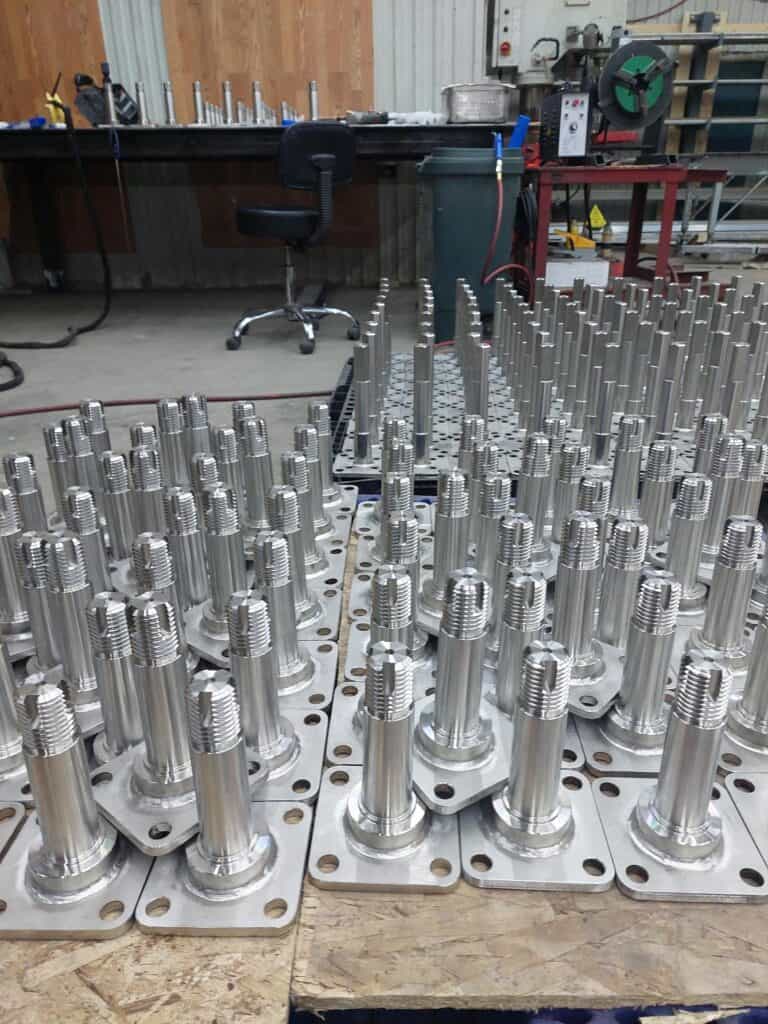
New updates: pipe cutting
MSG Industries provides services to a broad range of industry, and is constantly looking at ways to innovate and expand its offering.
“Our strength has always been our versatility. We have a department dedicated to heavy structural fabrication, such as schools or hospital building pieces, another department for food factory equipment, one for hydropower products, and then we have pipe cutting and laser cutting services,” explains Samson.
“Since we have so many different departments, we need very reliable tools to help us quote, and Tempus Tools has been highly valuable to us.”
“Our major focus right now is working on our pipe cutting laser service, and Tempus Tools is already working on adding this functionality into Tempus Tools so that we can quote for this service too – it’s very exciting.”
Turning customer PDFs into quote-ready CAD files
Tempus Tools Director Felipe Lechuga says that the discovery of Tempus Tools PDF part extractor feature was a further benefit to MSG Industries.
“MSG had just been using Tempus Tools for creating new quotes, but when they discovered they could use the PDF part extractor to turn a customer’s vector PDF into a CAD file straight away with no tracing required – they were delighted with the results,” said Lechuga.
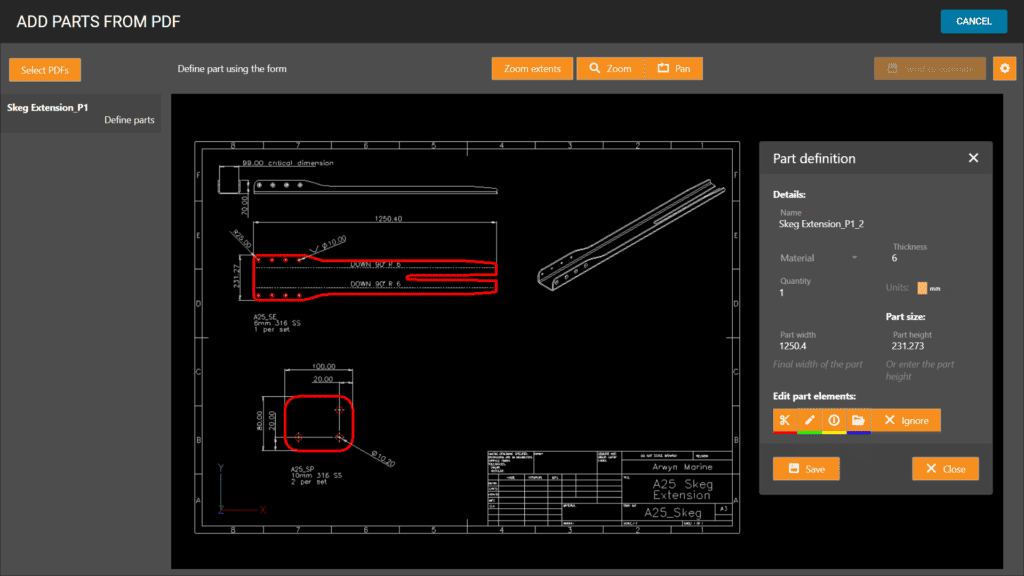
“The PDF part extractor doesn’t need any CAD package or skills to use, meaning anyone can simply click on a part and extract it into a quote. You can scale the part, plus specify details like folding and etching too.”
Olivier Samson says he can’t believe he didn’t try the PDF part extractor right away. “This is even more than we hoped for. Such a useful tool! I wish we’d tried out these features from the beginning.”
“I’ve found that Tempus Tools is reliable and fast, and Tempus Tools is actively working on updates, so we really couldn’t ask for more!” he concluded.
Read blog
Resources
Product updates
Product updates
0
min read
New integration: Tempus Tools + ECI M1 – from quote to order to ERP, seamlessly
At Tempus Tools, we know that speed and accuracy are everything in a laser cutting job shop, and today we’re announcing a new integration that makes both even easier.
We’re now fully integrated with ECI Software’s M1 ERP system.

What does that mean for your job shop?
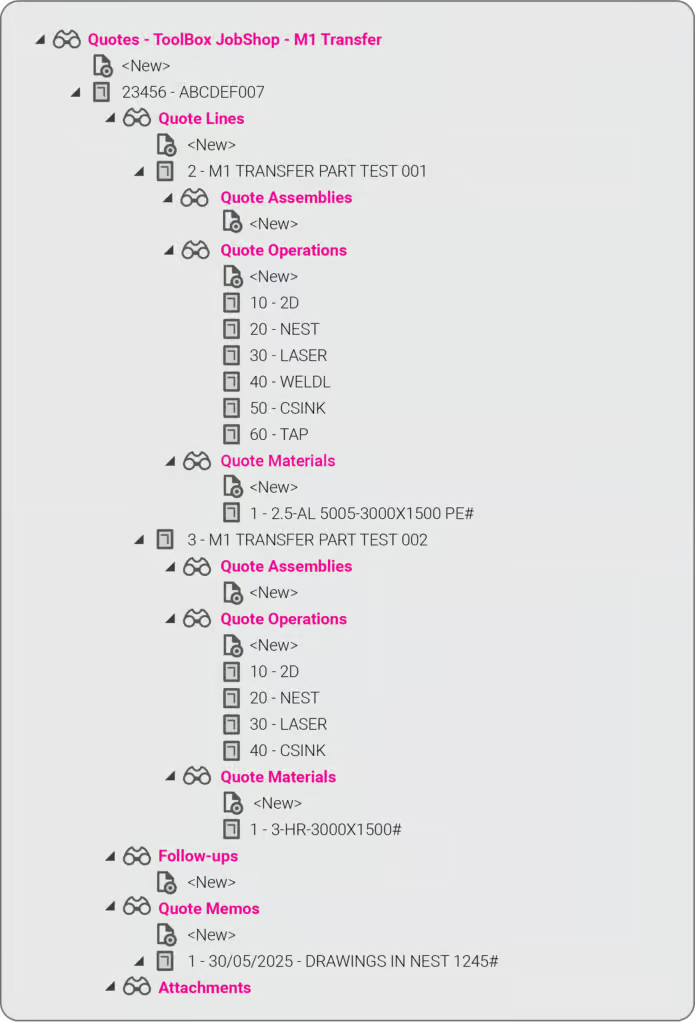
It means you can now send quotes, order details, and production-ready drawings directly from Tempus Tools into your M1 ERP — no more double handling, no more data entry errors, no more jumping between systems.
This integration eliminates any “dead zone” between quoting and production. You get the specialist laser quoting power of Tempus Tools (like lightning-fast nesting, material cost accuracy, and margin control) combined with the operational backbone of M1.
It’s quoting that talks to your shop floor.
We’ve talked about how integrations like Google Drive can supercharge job shop workflows, and this M1 integration is another great example.
Want to learn more or set it up? If you want to avoid the limitations in the generic quoting functions in ERP/MRP software, but still use the rich planning and production features in ERP/MRP software, then get in touch today.
Book a demo or email us at support@tempustools.com and we’ll help you get connected.
Tempus Tools + M1 = quoting to production, finally in sync.
Read blog
Product updates
0
min read
Tempus Tools’ Google Drive integration: 6 ways to supercharge your job shop efficiency
Tempus Tools’ new Google Drive integration automatically saves your quote data and part files to Drive, opening the door to faster, smarter workflows. In this post, we highlight six clever ways job shops are already using it to boost efficiency.
Last month Tempus Tools released a powerful new feature: seamless integration with Google Drive.
Since then, we’ve heard from lots of customers about the innovative ways they have implemented this integration in their job shops, and we wanted to share the best six with you to inspire you to use the feature in your shop.
First, a quick recap: with the Google Drive integration, all your quote data (in CSV format) and production-ready part files can be automatically saved to your chosen Google Drive folder. From here, they can be exported to any number of programs or that data can be manipulated for many use cases, opening up a world of automation, reporting and connectivity for your job shop. We’ve also put together a quick video to show the integration in action.
1. Automate quote data collection for reporting
With every quote automatically saved, you can easily compile and analyse your quote performance over time. Use Google Sheets or your favourite analytics tool to track:
- win/loss rates
- performance across material types
- average order size
- breakdown of secondary processes contributions
This data-driven approach helps you identify trends, optimise pricing and improve customer response times.
2. Connect with ERP/MRP and other business systems
Some apps have native integration with Google Drive, which makes taking in quote data and parts easy, but many need a formal API. Luckily, Google Drive comes with its own API.
Some users have used the Google Drive API to build automations that push quote data directly into ERP, MRP or order management systems. This can streamline order processing, reduce manual data entry and ensure your production schedule is always up to date.
3. Organise your orders by material type
Use the exported quote data to create a parts planner that groups jobs by common material type. This enables you to:
- batch similar jobs for more efficient material usage
- reduce changeover times on machines
- optimise purchasing and inventory management
A simple Google Sheets script or integration with a dashboard tool can make this process nearly automatic.
4. Integrate with project management tools
Connect your quote data with popular tools like ClickUp, Monday.com or Airtable. Build custom dashboards and planners for your factory, visualise job statuses and assign tasks to your team-all based on real-time quoting data. These tools don’t require coding or a developer and anyone can work wonders. These types of projects boost collaboration on the shop floor and keep everyone aligned on priorities.
5. Create a scheduling calendar from time calculations
Use the time estimates in your quote data to automatically populate a production calendar. With a Google Calendar integration, you can:
- visualise machine and operator workloads
- identify bottlenecks before they happen
- easily adjust schedules as new jobs come in
This proactive scheduling helps you deliver on time, every time.
6. Enable automated notifications and workflows
Set up Google Drive triggers (using tools like Zapier or Google Apps Script) to notify your team when new quotes are confirmed as orders, or to kick off downstream processes-like updating CRM records or ordering materials.
Getting started is easy
- Go to Settings > Organisation settings > Integrations in your Tempus Tools Tempus Tools account
- Connect your Google Drive and select your preferred folder
- Choose the quote statuses that will trigger automatic file saving
- Start building automations and workflows that fit your shop’s needs
This integration is designed to be flexible-whether you want to automate reporting, connect with business systems, or simply keep your files organised, Tempus Tools and Google Drive make it possible.
Ready to enhance your job shop efficiency? Try the new Google Drive integration today.
Read blog
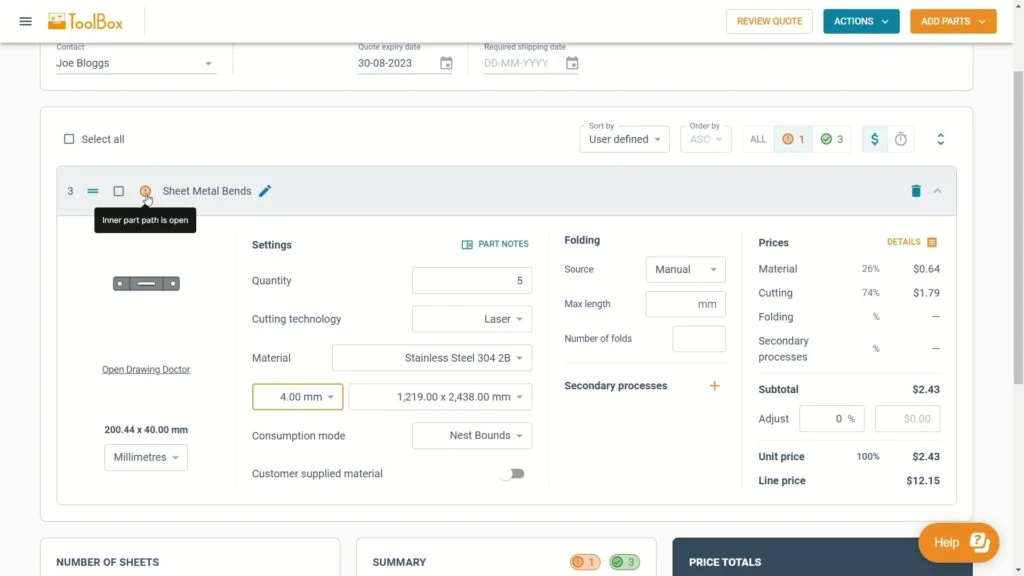
Product updates
0
min read
Tempus Tool’s new laser cutting quoting experience
Tempus Tool's new quoting interface delivers faster calculations, cleaner navigation, and powerful new features—all in one unified, intuitive screen. From smarter sorting to automatic updates and richer quote details, the upgraded experience makes quoting simpler, quicker, and more efficient than ever.
After months of rigorous development and innovation, we’re thrilled to unveil the newest evolution of our quoting interface in Tempus Tools. We remain committed to enhancing your laser cutting quoting process. This fresh approach promises enhanced navigation, lightning-fast calculations, and a host of exciting new features.
We have collected your feedback and listened to your concerns and requests over the past couple of years, and our design team has used their magic to put together a quoting interface that takes Tempus Tools to the next level!
Watch our new Tempus Tools Overview video to see all changes in detail:
Read on to learn more about some of the enhancements.
Tailored sorting
You’re in complete control. Choose between the smart auto-sort feature or manually arrange parts using drag-and-drop for a seamless organisation that aligns with your preferences.
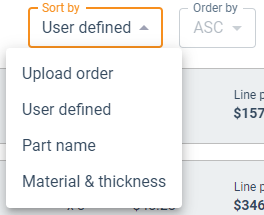
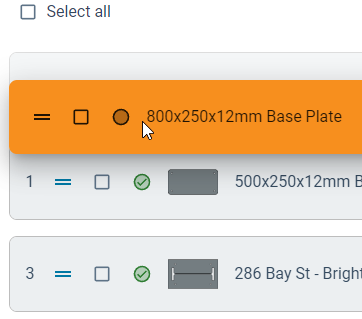
Material requirements and order summary
At a glance, get an indication of how many sheets you need of each material to fulfil the order. Additionally, the order summary details information such as the total order weight, processing time and part count.
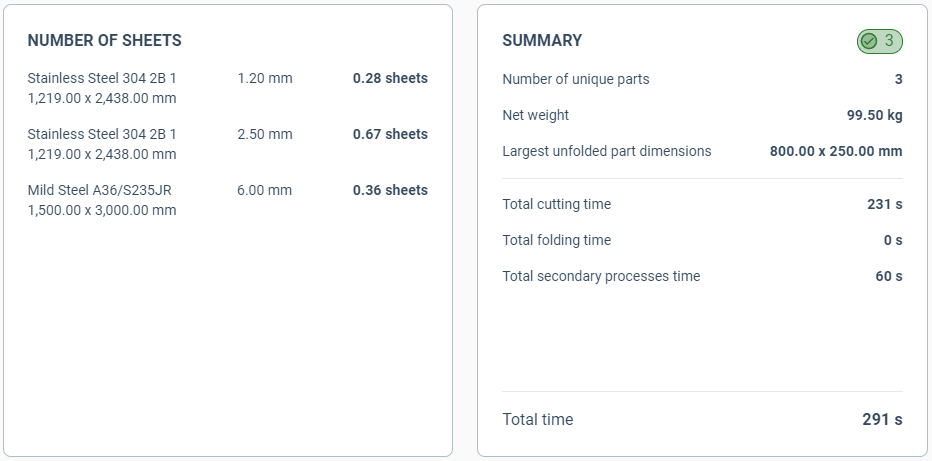
Part notes for everyone
A dedicated section for notes, whether they come from your customers, your team, or personal reminders for a job.
Streamlined price adjustments
With our revamped interface, tweaking the prices of parts becomes an intuitive and quick task.
Extra quote details
From setting an RFQ number to determining invoice due dates, shipping options, and beyond – we’ve got it all.

Unified quoting screen
No more toggling between tabs. Every bit of information you need, all consolidated on a single, intuitive page.
Automatic calculations
Forget the constant back and forth with the Calculate and Edit buttons. Our system now recalculates on-the-fly, keeping up with your pace.
Sleeker interface
With a cleaner, fresher look, onboard new team members with ease and navigate your daily tasks faster.
Customer emailing enhancements
An integrated system to keep your customers in the loop for every quote status.
In short, quoting in Tempus Tools is now even simpler and smarter. We’ve made sure it’s user-friendly while still being packed with all the features you need. Dive in and check out all the new improvements!
Accessing the new quoting experience
If you’re new to Tempus Tools, you will get the new experience by default. Just create a Tempus Tools account to get started.
For existing users, you have a temporary period to switch back and forth between the old and new experiences using the toggle at the top of the quote page.
We believe the new quoting experience will significantly enhance your quoting efficiency, and we can’t wait for your feedback.
Read blog
Ready to take a closer look at Tempus Tools?
Find out if Tempus Tools is a good fit for your shop in just 30 minutes.
Upload your own parts for a live demo
Get answers to pricing and setup questions
No-pressure call focused on your workflow